Research
My graduate research is in applied partial differential equations, with particular attention to the transition from particle systems to continuum mechanics via mean-field limits. I am also engaged in bifurcation analysis, examining the behavior of bifurcation points as models transition between variants dominated by different modes. Both projects involve numerical simulation and form part of my graduate work at Michigan State University (MSU).
Prior to pursuing a doctoral degree, I conducted research in water-sustainability policy as a data scientist and in differential algebra as a master's student of Dr. Taylor Dupuy. The former resulted in a publication with the research group of Dr. Meredith Niles. The latter was unfortunately cut short by the transition from my undergraduate institution, the University of Vermont (UVM), to graduate school.
The bulk of my undergraduate research was in chemistry, particularly in analytic and physical fields. My thesis investigated the photophysical mechanisms of organic molecules exhibiting anomalous fluorescence. I also developed protocols for the field use of a novel extraction method for semivolatile aerosols and explored the integration of machine learning techniques into computational chemistry curricula.
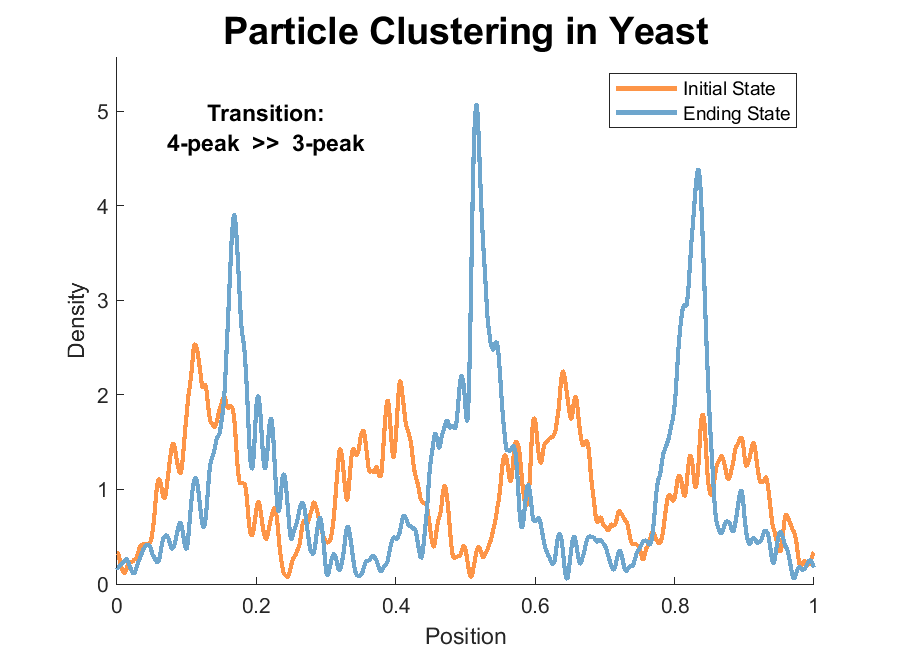
Yeast metabolism exhibits an asymmetric, nonlocal, spatially inhomogeneous interactions between agents that produces complex dynamics in both the particle and continuum settings. The particle system is modeled by a collection of coupled ordinary differential equations (ODEs) while the continuum solution is characterized by a partial differential equation (PDE). The derivation of this continuum solution as the limiting behavior of the particle system is an open problem. Preliminary numerical simulations suggest the models exhibit qualitatively similar behavior, although quantifying a rate of convergence remains challenging. This is of relevance to both the biological aim of understanding temporal clustering observed in yeast cultures and the mathematical aim of better understanding mean-field limits and their deviations.
Investigation of this mean-field limit and characterization of its dependencies is the primary objective of my doctoral thesis. Under the supervision of Dr. Keith Promislow, I have developed numerical schemes for accurate simulation of both particle and continuum models and identified the interaction kernel as outside the scope of current mean-field literature. Current avenues of investigation include the spectral stability of stationary and temporally periodic solutions, generalization of our numerical scheme to higher-dimensional Vlasov-type equations, and the application of machine-learning to approximate error terms in the BBGKY hierarchy.
Early results of this project were presented at the Amsterdam Centre for Dynamics and Computations Autumn School (poster available here), and a broader discussion of novel mean-field analyses was presented at the Institute for Pure and Applied Mathematics (IPAM).
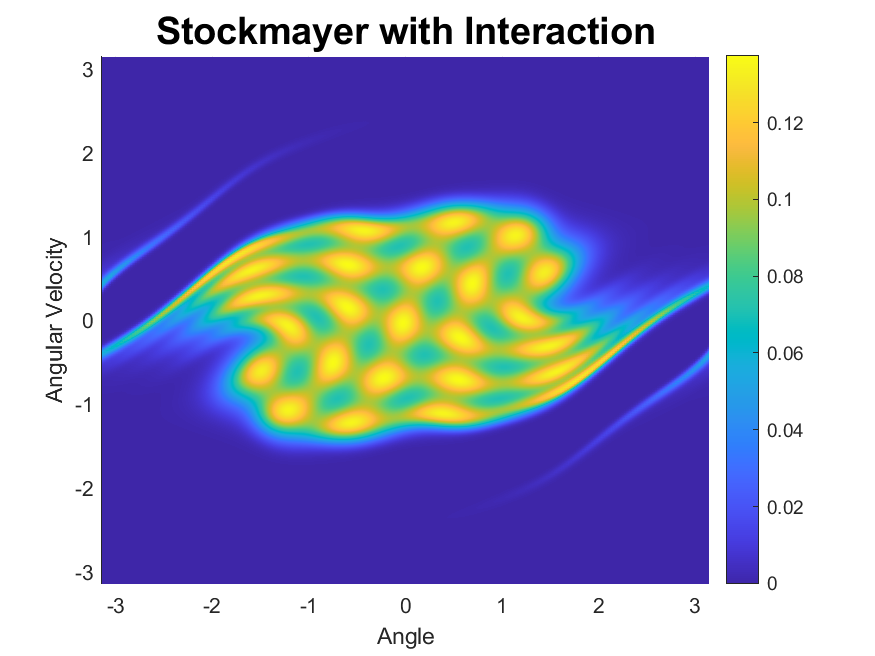
The high-dimensional nature of electrochemical settings poses a challenge to the design of computationally tractable models. Specifically, realistic simulation using so-called ground-truth, atomistic, models is prohibitively expensive. Mean-field models reduce computational demand but can fail to capture the singular events responsible for salient electrochemical phenomena. The Institute for Pure and Applied Mathematics (IPAM) hosted a research program, Bridging the Gap: Transitioning from Deterministic to Stochastic Interaction Modeling in Electrochemistry, to investigate the transition from particle to continuum models and develop new analytical and computational approaches to electrochemical modeling.
Over the course of a three-month program, I contributed to the development and implementation of a novel mean-field model for simulating the electrochemical behavior of water. Participants included students and associates of Drs. Keith Promislow, Katsuyo Thornton, and Chris Andersen. My principal contributions centered on the design and implementation of a numerical scheme, pairing pseudospectral spatial discretization with exponential integration and dimension-splitting (Trotterization), to simulate the new model. The resulting method exhibits both spectral accuracy and unconditional time stability and eliminates the numerical heating observed with other schemes.
As part of end-of-program presentations, both the model and simulations were presented at a culminating retreat, and results were summarized in a white paper. Research is ongoing, both in the electrochemical setting and in extending the numerical methods to other mean-field problems.
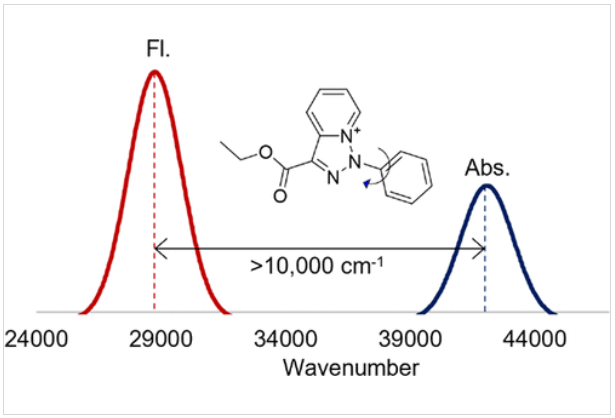
Stokes shifts serve as one of the most important indicators of a molecule's potential in light-emitting technologies. In brief, small Stokes shifts admit aggregation-caused quenching (ACQ), a phenomenon by which luminescence is effectively disabled. This precludes application in such burgeoning technological fields as fluorescence-based medical imaging and organic light-emitting diodes (OLEDs). The discovery of organic molecules with large Stokes shifts promises to overcome this challenge and broaden the pool of viable candidates for technological application.
The greatest achievement of my undergraduate career was elucidating the photophysical mechanism underlying large Stokes shifts in triazolopyridinium and triazoloquinolinium dyes. Collaborating with Drs. Morgan Cousins and Matthew Liptak, I conducted computational chemical analysis using the ORCA implementation of density functional theory. This revealed a novel mechanism for large Stokes shifts based on the inversion of aromatic stability upon excitation.
The project was presented at an annual UVM Student Research Conference (poster available here) and included in my undergraduate thesis: Petrucci, Adam N., "Modeling of Photophysical Phenomena: Anomalies to Kasha's Rule and Conventional Stokes Shifts" (2021). UVM College of Arts and Sciences College Honors Theses. 93. Finally, I am most proud of the peer-reviewed publication of my research: Adam N. Petrucci, Morgan E. Cousins, Matthew D. Liptak, “Beyond "Mega": Origin of the "Giga" Stokes Shifts of Triazolopyrdiniums.” J. Phys. Chem. B, 2022, 126: 6997-7005.
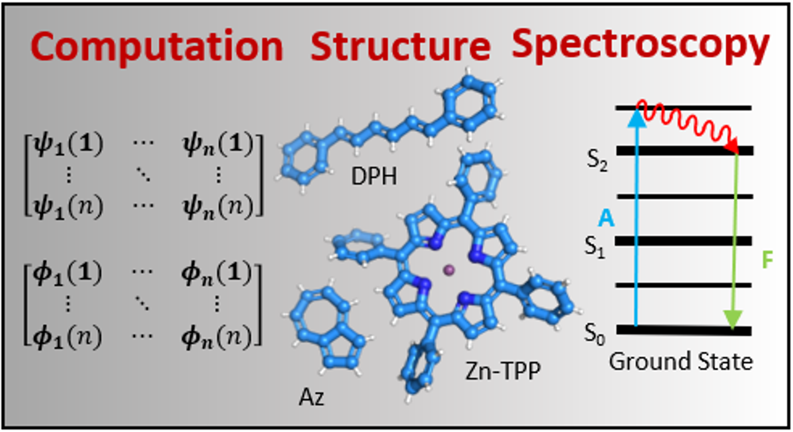
Aggregation-induced emission (AIE) offers a means of preserving photophysical properties in solid or aggregated states. As the converse to ACQ (discussed above), this phenomenon is particularly relevant to the development of organic OLEDs and sustainable electronics. Moreover, within the photophysics community, ACQ has long been accepted as standard behavior, whereas AIE is historically considered a rarity. Consequently, AIE is not only of practical use, but also of great academic interest.
Investigation of the Suppression of Kasha's Rule (SOKR) as a photophysical mechanism for AIE inaugurated my undergraduate research career. Under the mentorship of Dr. Matthew Liptak and then-graduate student Morgan Cousins, I applied absorbance and fluorescence spectroscopy, paired with computational experiments, to elucidate photophysical mechanisms. The project also employed nuclear magnetic resonance spectroscopy to investigate the photoinduced isomerization of the principal molecule of interest, all-
The results of this project were presented at the Champlain Area Chemistry Symposium, (poster available here) and included in my undergraduate honors thesis: Petrucci, Adam N., "Modeling of Photophysical Phenomena: Anomalies to Kasha’s Rule and Conventional Stokes Shifts" (2021). UVM College of Arts and Sciences College Honors Theses. 93.
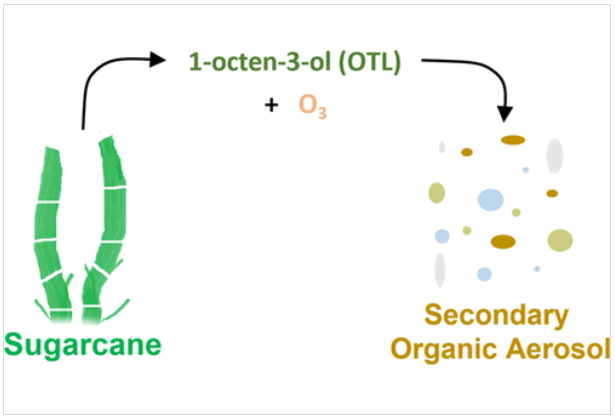
Secondary organic aerosols (SOAs) significantly alter the optical properties of fluids. This has prosed a challenge at National Aeronautics and Space Administration (NASA) research and launch sites, which are often located in isolated regions used for the cultivation of SOA-emitting crops, such as sugar cane. The technique of solid-phase microextraction (SPME) was developed to facilitate on-site collection of SOA samples.
The Organic Aerosol Research Studies (OARS) Laboratory at the University of Vermont, headed by Dr. Giuseppe Petrucci, specializes in analytical atmospheric chemistry and hosted me as an intern. Under the guidance of then-graduate student Rebecca Harvey, I assessed and quantified the efficacy of SPME for SOA collection using coupled gas chromatography-massspectrometry (GC-MS). This project served as the culmination of my membership in Essex High School's STEM Academy and initiated my career in academic research.
My results contributed to a peer-reviewed ACS publication: Kevin B. Fischer, Clarissa S. Gold, Rebecca M. Harvey, Adam N. Petrucci, Giuseppe A. Petrucci, “Ozonolysis Chemistry and Phase Behavior of 1-Octen-3-ol-Derived Secondary Organic Aerosols.” ACS Earth Space Chem., 2020, 4(8): 1298-1308