Expository Talks
Monday, June 29th
Given a countable discrete group acting on a probability space, one can define the crossed product von Neumann algebra. Also called the group measure space construction, this von Neumann algebra is generated by the abelian von Neumann algebra given by the measure space and the group von Neumann algebra of the countable discrete group. The relation between these two von Neumann algebras inside the crossed product is given by the commutation relation induced by the action of the group. We show that if the action is free and ergodic, then the crossed product von Neumann algebra is a factor. Consider the group measure space construction of a countable discrete group acting on a standard probability space. Turns out that if the action is free, then the von Neumann algebra only depends on the equivalence relation induced by the action on the measure space. Given a standard Borel equivalence relation, one can define the equivalence relation von Neumann algebra. We give this definition and mention Feldman and Moore's result about Cartan inclusions.1:30-2:20 pm | Fehmi Ekin Giritlioglu, Michigan State University: The Group Measure Space Construction (Notes)
2:50-4:20 pm | Problem Session
4:30-5:20 pm | Fehmi Ekin Giritlioglu, Michigan State University: Equivalence Relation von Neumann Algebras
Tuesday, June 30th
In this talk, we will talk about the basic construction of a C*-algebra from a directed graph using generators and relations. We will discuss the Cuntz-Krieger and gauge-invariant uniqueness theorems, and conclude with a discussion on Condition (K) and ideals in graph algebras. Hilbert C*-modules are an important gadget in C*-algebras with a wide variety of applications. After introducing Hilbert modules, we will discuss how the Cuntz-Pimsner algebra is obtained from a C*-correspondence (Hilbert bi-module), and how this is used to define the C*-algebra of a topological graph.1:30-2:20 pm | Gregory Faurot, Ohio State University: Introduction to Graph C*-Algebras (Notes)
2:50-4:20 pm | Problem Session
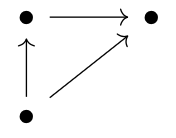 Prove that $C^*(F)\cong M_4(\mathbb{C})$. More generally, prove that if $E$ is a finite graph with no cycles, then
$$C^*(E)\cong \bigoplus_{\text{sources $v \in E^0$}}M_{n(v)}(\mathbb{C})$$
where $n(v)$ is the number of paths in $E$ starting at $v$ (including the length-zero path $v$).
Prove that $C^*(F)\cong M_4(\mathbb{C})$. More generally, prove that if $E$ is a finite graph with no cycles, then
$$C^*(E)\cong \bigoplus_{\text{sources $v \in E^0$}}M_{n(v)}(\mathbb{C})$$
where $n(v)$ is the number of paths in $E$ starting at $v$ (including the length-zero path $v$).
[Hint: Use the previous exercise; you may further assume that $C^*(E)$ is densely spanned by $s_\lambda s_\mu^*$ where $s(\lambda)=s(\mu)$.]
[Hint: Use the second Cuntz--Krieger relation $p_w=\sum_{e \in r^{-1}(w)}s_es_e^*$.]
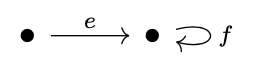 Prove that $C^*(E)$ is isomorphic to the Toeplitz algebra $\mathcal{T}$. [Hint: Consider the isometry $s_e+s_f$.]
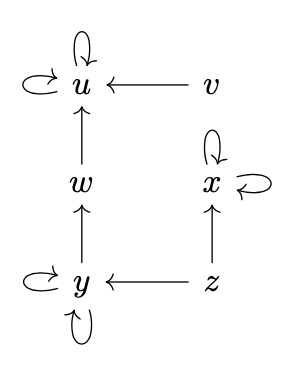 Verify that $E$ satisfies Condition (K). Construct the ideal lattice of $C^*(E)$.
4:30-5:20 pm | Gregory Faurot, Ohio State University: Hilbert C*-modules, Cuntz-Pimsner Algebras, and Topological Graphs (Notes)
Wednesday, July 1st
I will discuss the construction of an abelian group denote $K_0(A)$ from a unital C*-algebra, $A$. The construction involves projections in the matrix algebras over $A$ along with the Grothendieck construction of an abelian group from an abelian semigroup. A number of concrete examples will be discussed. After introducing $K_1(A)$, I will discuss how $K_0$ and $K_1$ are related via a six-term exact sequence. A number of (other) six-term exact sequences will be introduced and some computations will be discussed. For example, we will compute the K-theory groups of the crossed product $C^*$-algebra associated with the odometer action on the Cantor set.1:30-2:20 pm | Robin Deeley, University of Colorado, Boulder: The $K_0$ group of a unital C*-algebra
2:50-4:20 pm | Problem Session
[Hint: This requires a general theorem about the $K_0$-group of direct sums (which you should try to prove) and a theorem about the structure of a finite dimensional $C^*$-algebra (which appears in Chapter 8 of the GOALS $C^*$-algebra notes).]
[Hint: start by writing each algebra as an inductive limit of finite dimensional algebras.]
4:30-5:20 pm | Robin Deeley, University of Colorado, Boulder: Computing $K$-theory via six-term exact sequences
Thursday, July 2nd
We motivate the study of subfactors and zoom in on some basic examples (which, alas, arise from finite group theory) and the tools—the index and basic construction—which give us our first handles on subfactors. We will outline a proof of Jones’ index theorem and delve into the role of the Temperley–Lieb agebra, as well as some more interesting examples of subfactors.1:30-2:20 pm | Emily Peters, Loyola University Chicago: Subfactors: why and how?
2:50-4:20 pm | Problem Session
4:30-5:20 pm | Emily Peters, Loyola University Chicago: Subfactors: Jones’ Index Theorem and the Temperley-Lieb algebra