MTH 235
Honors Lab01 Conservation of the Energy
Introduction
We use the conservation of the energy, described in Section 2.4 of the Lecture Notes, to integrate the equation of motion that describes a projectile leaving the Earth gravitational attraction. This lab has two main parts.
- The first part is mainly analytical work needed to obtain the conservation of the energy statement for a particle in a gravitational potential. We use this conservation to obtain the escape velocity from Earth. We then generalize the Earth escape velocity to compute the escape velocity of all eight planets in the solar system.
- The second part we send a projectile to from Earth to the Moon. We need to find the time it takes to the projectile to get to the Moon if it is sent with initial velocity equal to the Earth escape velocity.
- The universal gravitational constant, \(G = 6.67 \times 10^{-11} {\rm N \,m}^2/{\rm kg}^2\), and one Newton is \(N = 1 \;{\rm kg\, m}/{\rm s}^2\).
- Newton's gravitational law says that the gravitational force between two objects of masses \(M\)and \(m\) separated by a distance \(r\) is \[ f(r) = -\frac{GMm}{r^2}. \]
- The mass of the Earth, \(M_E = 5,973.6 \times 10^{21} \; {\rm kg}\).
- The radius of the Earth, \(R = 6,371 \;{\rm km}\).
- Distance from the center of the Earth to the Moon, \(R_{EM} = 405,696 \;{\rm km}\).
Escape Velocities
Consider a projectile that moves upwards in the vertical direction starting from the Earth surface. Denote by \(y(t)\) the position of the projectile at the time \(t\) measured from the surface of the Earth, as in the picture below.
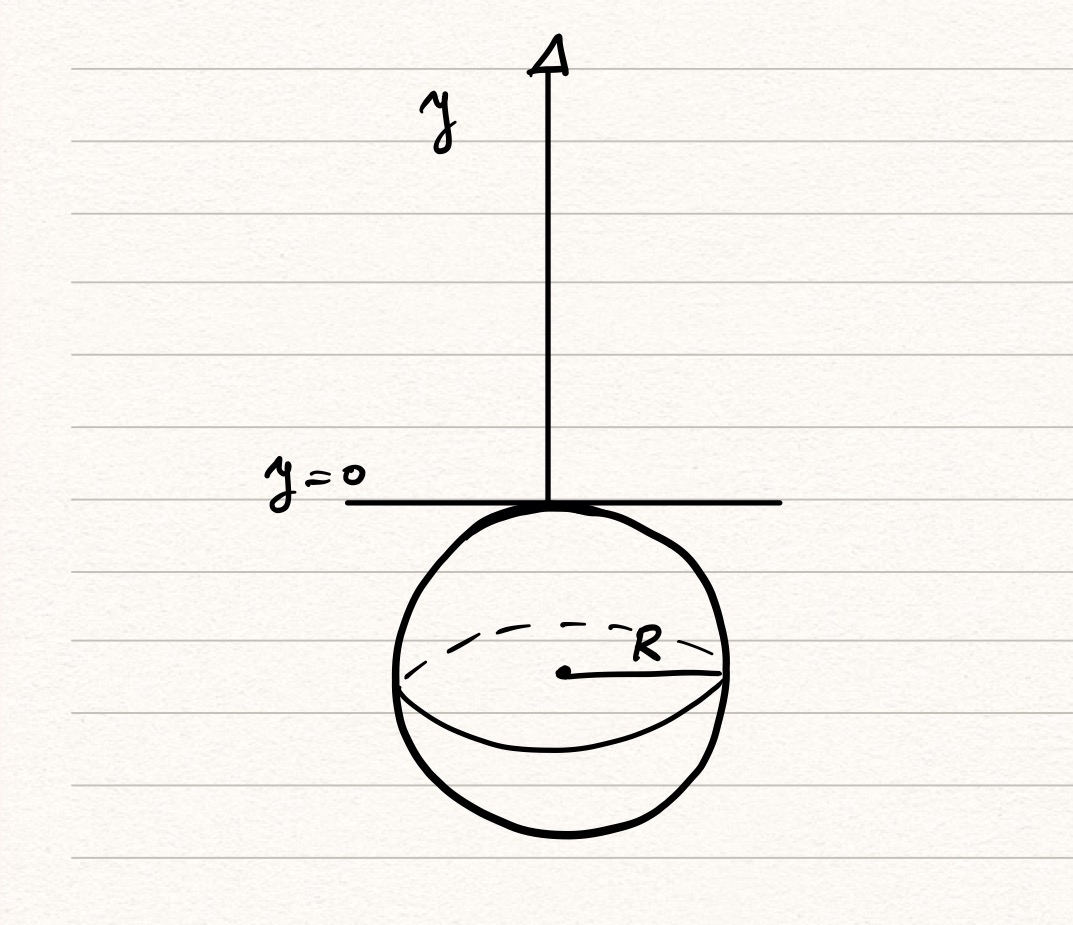
Recall that the escape velocity from a planet is the smallest initial speed \(v_0\) such that \(v(t)\) is defined for all \(y(t)\) including in the limit where \(y\) approaches infinity. Assume that the projectile is launched from the surface of the Earth with an initial speed \(v_0\).
- (1pt) Write the equation of motion for the position function \(y\) of the projectile.
- (1pt) Find the energy E of this system as function of the projectile position \(y\) and speed \(v = y'\), and write the energy conservation for this system.
- (1pt) Find the escape velocity from Earth, \(v_e\) in \({\rm km/s}\).
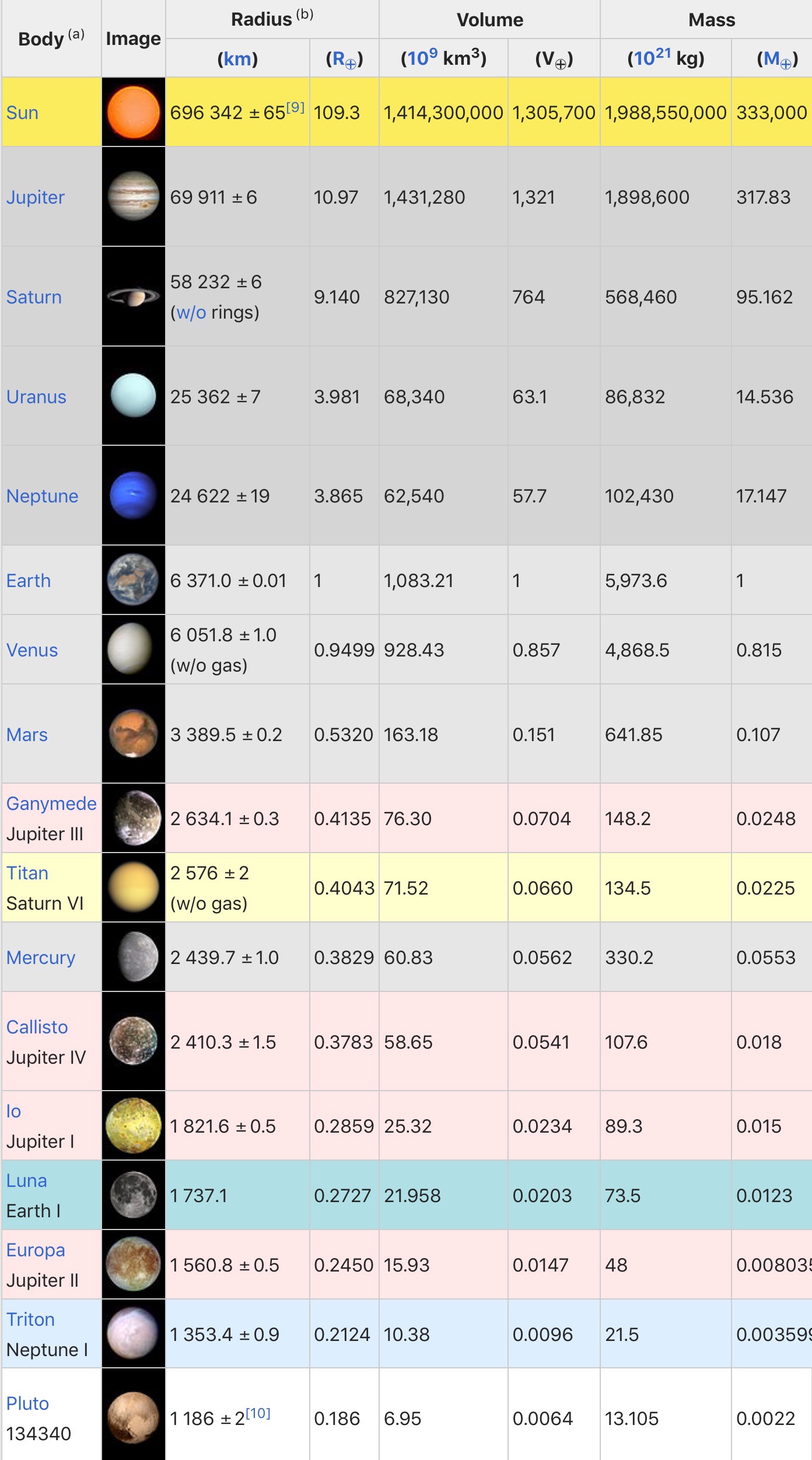
- (1pt) Generalize the calculations done in the previous part for the Earth to any planet of mass \(M\) and radius \(R\). Use the table below to compute the escape velocity of the eight planets in the solar system and the Earth Moon, in \({\rm km/s}\).
Time Travel Earth to the Moon
We send a projectile to from Earth to the Moon lanched at the Earth escape velocity.- (2pts) Use one of the intial conditions \(y(0) =0\) and \(y'(0) = v_e\) to write the energy conservation equation found in the previous part.
- (2pts) Solve the differential equation for the position function \(y(t)\), using the other initial condition, and find an implicit solution.
- (2pts) Then find the \(t(y)\), the time as function of position and evaluate that time function at \(y = R_{EM} - R\). This is the time \(t_{M_1}\) to reach the Moon. Compute this time in hours.