Here is a method to adjust the toe-in on your trike.
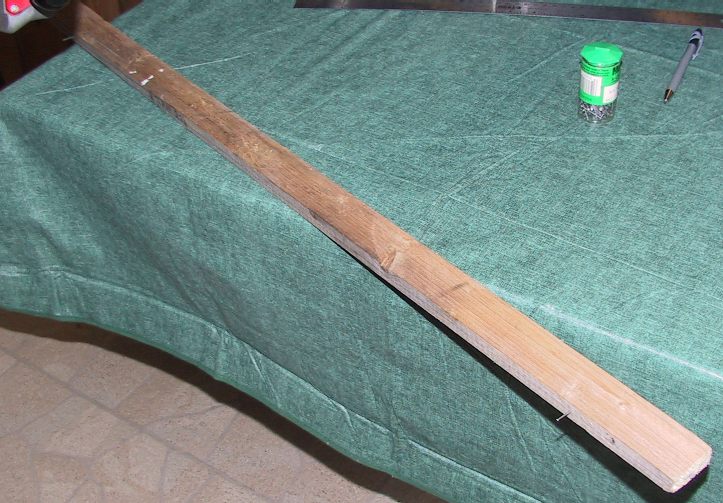
You need a scrap of wood at least as long as the distance between the front wheels, two thin nails or brads, cutter to cut the heads of the nails off (optional), two pieces of tape, pencil or pen, and something like a hammer to push the nails into the wood would be nice. The instructions are a little long-winded, but this is a fast and accurate way. For me it is more accurate than trying to take direct measurements. Notice that you are not taking any measurements with numbers:
Hold your scrap of wood against the front tires and make a mark where the centers of the tires are. Drive in two nails near those marks and cut off the heads so you have two sharp pins sticking out of the wood.
Put a piece of tape on each front tire. Make a horizontal mark across each tape. Lay your piece of wood across the front tube or boom, keep it level (by eye is good enough) and rotate the front wheels until the sharp pins touch the tape at the horizontal marks. Put the brake on (Velcro strip, rubber band, or whatever you use.) Now mark the height of horizontal mark on your stick. (Fiddle until each horizontal mark is at the same height if need be.) Push just hard enough to make a dimple or small hole in the tape. Put a circle around each point where the sharp pin met the tape. The angle doesn't show the pins piercing the tapes but you get the idea:
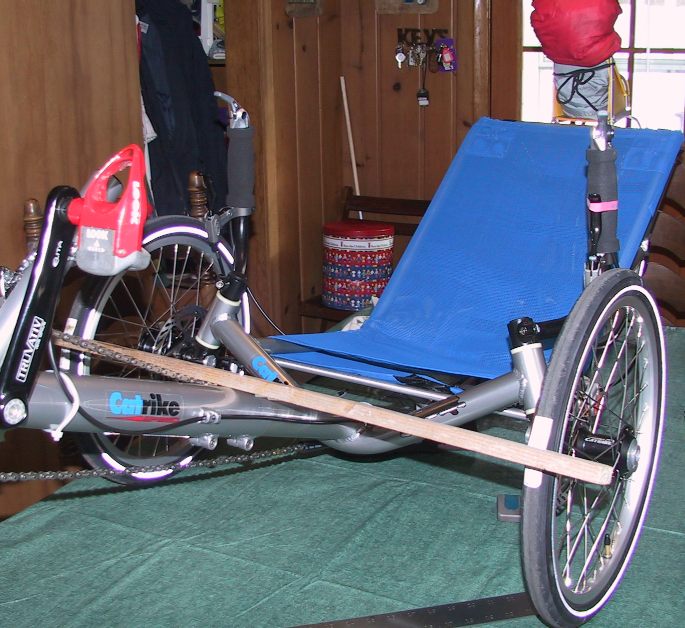
Now take the brake off and rotate the tires back until those horizontal marks are in back and at the same height as before. Put the brake back on. Put one of the sharp pins in the same hole or dimple as before, and mark where the other pin meets the tape on the horizontal line.
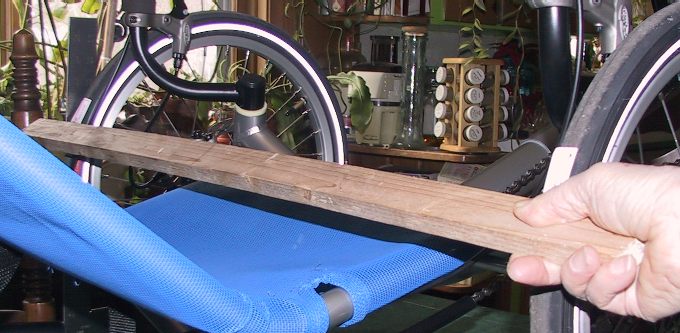
If the second pin meets the tape on the horizontal line exactly in the same spot as before, then you have 0 toe-in. But it probably won't. Mark where that second pin meets the tape. Notice the distance between the new mark and the old mark. Loosen the locknuts on the tie rod and rotate the tie rod until you have reduced that distance to half. It is more accurate to do this by eye than to measure. Now tighten the locknuts. To be sure, now repeat the procedure. This time you should have the same distances in front and back.
For more accuracy, have someone sit in your trike, holding something if necessary, so that person weighs about what you do while measuring. Or better yet, you sit in the trike and have someone else do the measurements. From what I have gleaned from some postings at trike websites, for some trikes it is crucial to have the trike loaded with the correct weight while measuring. I've also seen a posting that recommends you ride the trike into position for measuring rather than just setting it down because you'll get a more accurate measurement that way.
If the steering with 0 toe-in doesn't feel good to you, try adding just a little toe-in, say about 1 mm and see how that feels. In other words, the distance in front should be about 1 mm less than in back. This is not exactly your toe-in because it is not at the height of the axels, but it's close enough. The steering might feel more stable to you with a little toe-in. If that doesn't feel good, try a little more toe-in. Of course, the more toe-in you have, the more tire wear you have. Also, what feels good could change if you switch to different tires.
At the Wizwheelz bulletin board someone recommends doing the final adjustment while coasting down a steep smooth hill and listening to the tires. The least noise (least tire scrub) should be at 0 toe-in. I haven't tried that. It sounds like a nice idea.
If you have an older trike with the steering a little loose, you probably need to increase the toe-in to accommodate the looseness. To get a rough estimate of how much toe-in you need, grab both front wheels in front and wiggle from side to side. If you have a lot of miles on your trike and haven't done an overhaul yet then you will probably have some play: the difference in distances from the fronts of the tires when pushing in and pushing out. Measure the amount of play and double that. This should give you a good first approximation to your desired toe-in. For example if you get 1 mm of play then you want your toe-in to be about 2 mm. Of course if you push harder then you will get more play. Just use your instincts. Try to guess how much side forces are applied when you are riding. You certainly don't want more toe-in than is necessary. If you feel any looseness or wandering when you ride then you might want to increase the toe-in.
Final alignment tip: Carry a piece of string with you. Not only if you find a treasure can you tie it on somewhere but also if the locknuts on the tie rod happen to come loose, you can do a quick rough alignment with your piece of string, assuming it is long enough to reach and that you carry a small wrench. You could mark the string right now where the centers of the tires in front at axel height are. That would be good enough to get you home.
You didn't like the method just described? Here is another way to set your toe-in to zero:
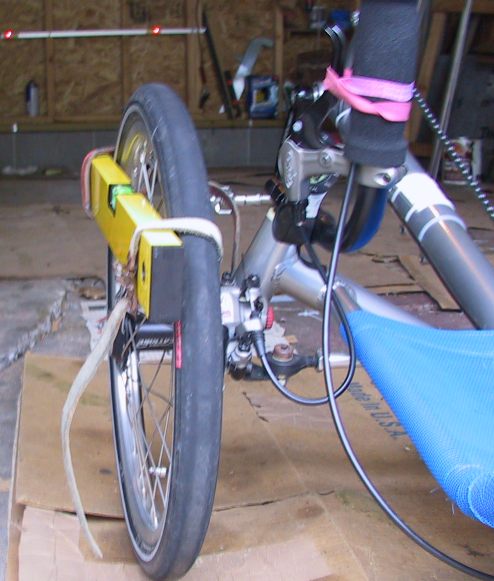
I got two laser levels cheap by mail order. Before you use them, you can tie them together, measure the distance between the beams near the levels and then far away to see if there is any skewness you need to deal with. I tied them onto the sides of the wheels at the same height front and back, both sides. I used old toe straps. The first experiment I did is I wanted to see if the rider's weight affects the toe-in. So I marked where the two beams hit the far wall before I sat down. Then I sat down to see if the distance between the two laser dots changed. For me, the dots moved closer so I know I want to be seated when I do the measurement. Maybe for someone heavier it matters more.
I hold a stick (or cardboard, metal strip, whatever) right in front of the laser levels and mark the distance between the beams. Then I go to the far wall, place the stick on the wall resting on two nails at the same height, and see if the beams are the same distance apart. While seated on the trike I turn and tighten the nuts on the tie rod until they are. Just to be sure, I repeat the experiment a few times, using different places on the tires. The photo is a little misleading. There are two bright, well defined laser dots on the measuring stick that is on the wall. The photo makes them look like two red smudges, but the dots are well defined to the eye. If you want a little toe-in, just adjust the tie rod length so the two laser spots move a little closer. My experience is that the Catrike handles very nicely with no toe-in, and when you get the toe-in set to zero very precisely, you can go for thousands of miles with very little tire wear.